Custom Basketball Jersey Maker: A Team's Complete Guide
A custom basketball jersey maker is a service or platform that lets youth and amateur teams design, print, and order personalized uniforms built around their colors, logos, and player names. The right jersey does more than look good on the court. It signals team identity, builds confidence before tip-off, and holds up through a full tournament schedule. This guide walks you through fabric choices, design options, the ordering process, and how to avoid the mistakes that cost teams time and money.
What should a custom basketball jersey maker offer your team?
The most important thing a custom basketball jersey maker provides is control. You choose the fabric, the colors, the print method, and the fit. That control matters because youth and amateur teams have specific needs: limited budgets, mixed size ranges, and tight deadlines before seasons or tournaments begin. Tnkusports is built around exactly those constraints, offering design assistance, proof reviews, and rush order options for teams that need uniforms fast.
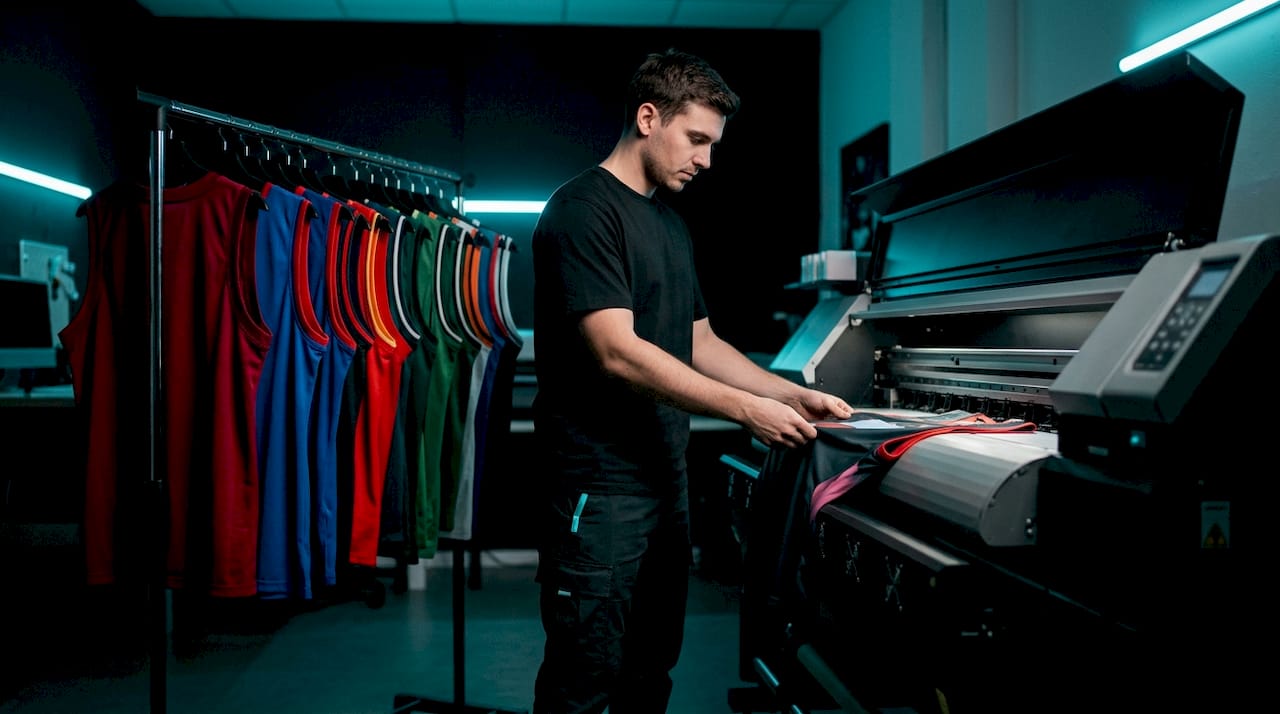
Sublimation printing is the industry standard for high-quality custom basketball jerseys. It bonds dye directly into the fabric rather than sitting on top, which means colors stay sharp through hundreds of washes. Transfer printing and heat press methods are also widely used, each offering different price points and durability levels.
What materials and fabric technologies should teams consider?
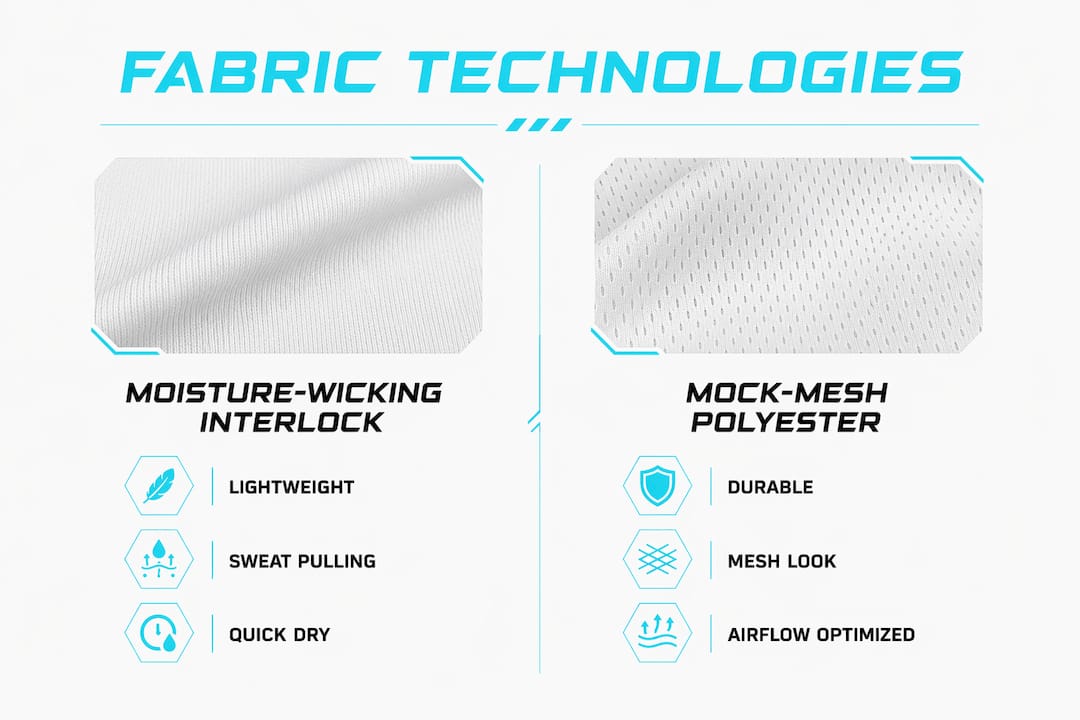
Fabric is the single most consequential decision in a jersey order. Performance fabrics like moisture-wicking interlock and mock-mesh polyester are the standard recommendation from experienced athletic directors for player comfort and temperature regulation during tournaments. That matters most during long play days when players rotate through multiple games with little rest.
Moisture-wicking interlock
Moisture-wicking interlock is a tightly knit polyester that pulls sweat away from the skin and dries quickly. It is lightweight, holds color well under sublimation printing, and works in most climates. Youth players benefit from its soft feel against the skin during extended wear.
Mock-mesh polyester
Mock-mesh polyester mimics the open-weave look of traditional mesh but without the structural weakness. It offers better airflow than interlock, making it the better choice for hot gyms or outdoor courts. The trade-off is that it is slightly less durable under heavy contact.
Dobby jacquard
Dobby jacquard is a premium woven fabric with a subtle texture pattern built into the weave itself. The 3000 Series jersey uses soft moisture-wicking dobby jacquard with transfer print customization, while the 2000 Series uses lightweight interlock polyester. Prices for these series range from $31.99 to $39.99 per jersey. That price difference reflects real differences in feel and durability, not just branding.
| Fabric type | Best for | Key advantage | Limitation |
|---|---|---|---|
| Moisture-wicking interlock | All climates, youth teams | Soft feel, durable | Less airflow than mesh |
| Mock-mesh polyester | Hot gyms, outdoor courts | Maximum breathability | Less durable under contact |
| Dobby jacquard | Premium uniforms | Rich texture, sharp print | Higher cost per unit |
Pro Tip: If your team plays in a gym without air conditioning, choose mock-mesh polyester. If you play in a climate-controlled facility, interlock gives you better durability for the same price.
How can teams design jerseys that reflect identity and meet league rules?
Custom basketball jersey design starts with your team’s color palette. Choose two to three colors maximum. More than three creates visual noise that makes numbers hard to read from the sideline or the scorer’s table. High contrast between the jersey base and the number color is not optional. Most leagues require numbers to be clearly visible from a set distance, and referees will flag jerseys that fail that standard.
Key design elements to lock in before you submit artwork:
- Team colors: Confirm your primary and secondary colors in Pantone or hex codes to avoid color drift between your screen and the final print.
- Logo placement: Chest center is the standard position. Side panels and back yoke placements are available but add complexity to the proof process.
- Player names and numbers: Use bold, block fonts for numbers. Script fonts look sharp in photos but lose legibility at game speed.
- Typography: Keep name fonts consistent across the full roster. Mixing fonts across jerseys makes a team look uncoordinated.
Reversible basketball jerseys solve a real problem for travel teams and tournament squads. One set of jerseys gives you two distinct looks, one for home games and one for away, without ordering two full sets. Many custom jersey makers offer full customization on both sides of reversible jerseys, which makes them a cost-effective choice for teams on a budget.
Customization techniques include sublimation printing, embroidery, screen printing, heat sealing, and tackle twill. Sublimation and heat press methods are the most common for basketball because they handle curved surfaces and complex color gradients better than embroidery. Embroidery works well for logos on collars or waistbands but is not practical for full-jersey graphics.
Pro Tip: Submit your logo as a vector file (.AI or .EPS) rather than a JPEG. Vector files scale without losing quality, which prevents pixelated logos on the final print.
Common design mistakes to avoid:
- Submitting low-resolution logo files
- Choosing colors that look similar under gym lighting
- Ignoring league number size requirements (most leagues require numbers at least 6 inches tall on the back)
- Adding too many design elements that compete for attention
- Forgetting to confirm sizing for each player before submitting the order
What is the step-by-step process for ordering custom basketball jerseys?
The ordering process follows a predictable sequence. Knowing each step in advance prevents the delays that push delivery past your season opener.
- Choose your jersey series. Decide between premium and lightweight options based on your budget and playing conditions. Confirm the fabric type and print method before moving forward.
- Submit your design. Provide your team colors, logo files, player names, and numbers. The more complete your submission, the faster the proof comes back.
- Review the tech pack and proof. Manufacturers send tech packs and test print photos for client approval before production begins. Review every detail: spelling, number placement, color accuracy, and sizing.
- Approve and place the order. Orders are finalized only after client sign-off. Do not rush this step. A missed error at proof stage becomes an expensive reorder.
- Confirm sizes and add shorts. Mix sizes freely within a single order. If you need matching shorts, add them to the same order to keep the uniform set consistent.
- Track production and delivery. Standard production runs 2–4 weeks. Rush orders can cut that to as little as two weeks depending on quantity and design complexity.
Minimum order quantities vary by supplier. Some start at 10 pieces with reorders allowed from a single item. Others require 25 sets minimum. Reorders on smaller quantities sometimes carry a processing fee, so ordering a few extra jerseys upfront is usually cheaper than a single reorder later.
| Order feature | Standard option | Rush option |
|---|---|---|
| Production time | 2–4 weeks | As fast as 2 weeks |
| Minimum order | 10–25 pieces | Varies by supplier |
| Reorder minimum | 1 piece (fees may apply) | Not always available |
| Proof turnaround | A few days | Expedited on request |
What are common challenges and how do teams avoid them?
Most jersey order problems trace back to three sources: unclear design files, sizing errors, and poor communication with the maker. Each is preventable.
Clear, timely communication with the manufacturer and precise logo files reduce revisions and speed up delivery. Every round of revision adds days to your timeline. Submit complete, accurate files the first time.
Do’s and don’ts for a smooth order:
- Do collect every player’s measurements before submitting the order. Youth sizing varies significantly between brands.
- Do confirm your league’s uniform rules on number size, color restrictions, and logo placement before finalizing the design.
- Do request a physical sample or test print if your order is large or your design is complex.
- Don’t approve a proof on a phone screen. Colors render differently on mobile displays than in print.
- Don’t wait until two weeks before your first game to start the order. Standard production takes 2–4 weeks, and shipping adds time on top of that.
- Don’t assume your logo file is print-ready. Confirm the format and resolution with the maker before submitting.
Budget planning matters too. Pricing tiers shift based on fabric choice, print method, and order quantity. Ordering more jerseys in a single run almost always lowers the per-unit cost. Factor in shipping, rush fees, and any reorder processing charges when building your total budget.
Key Takeaways
Choosing the right custom basketball jersey maker requires matching fabric, design method, and ordering timeline to your team’s specific needs and budget.
| Point | Details |
|---|---|
| Fabric drives performance | Choose moisture-wicking interlock or mock-mesh polyester based on your playing environment. |
| Design clarity wins | Submit vector logo files and confirm league number size rules before approving any proof. |
| Order early | Standard production takes 2–4 weeks; start the process at least six weeks before your first game. |
| Reversible jerseys save money | One reversible set covers both home and away looks, cutting uniform costs for travel teams. |
| Proof approval is final | Review every detail in the tech pack before sign-off. Errors caught late become expensive reorders. |
What I’ve learned coaching teams through jersey orders
Coaches and team managers often treat the jersey order as an afterthought. They focus on practice schedules and game strategy, then scramble for uniforms two weeks before the season. That scramble costs money and creates stress that spills into the locker room.
The teams I’ve seen get this right share one habit: they involve players in the design process early. Not in a way that creates chaos, but in a structured vote on two or three color options and logo placements. Players who feel ownership over their uniform wear it differently. They stand taller. They take care of it. That sounds small, but team confidence is a real competitive factor.
The other thing I’d push back on is the instinct to go cheap on fabric. A jersey that traps heat and soaks through by halftime is a distraction. Players fidget, they complain, and their focus drifts. Performance fabrics cost a little more per unit, but the return in player comfort over a full season is worth every dollar. I’ve never had a coach tell me they regretted spending more on better fabric. I’ve heard plenty regret going cheap.
Finally, read the proof like it’s a legal document. I’ve seen teams approve a proof with a misspelled player name because they were in a hurry. That jersey gets worn all season. Take the extra hour.
— Lisa
Tnkusports has custom basketball jerseys built for your team
Tnkusports offers custom basketball jerseys in moisture-wicking fabrics with full design customization, including player names, numbers, and team logos. The ordering process includes design assistance and proof review within a few days, so your team knows exactly what it’s getting before production starts.
Rush orders are available for teams with tight timelines, and the platform supports mixed size ranges within a single order. Whether you need a full basketball uniform set or a standalone jersey run, Tnkusports handles the design-to-delivery process with options built for youth and amateur programs. Visit tnkusports.com to start your order and get a proof back fast.
FAQ
What is the minimum order for custom basketball jerseys?
Minimum order quantities typically start at 10 pieces, though some suppliers require 25 sets. Reorders are often available from a single item but may carry a processing fee.
How long does it take to get custom basketball jerseys made?
Standard production takes 2–4 weeks from proof approval to delivery. Rush options can reduce that to as little as two weeks depending on order size and design complexity.
What is the best fabric for custom basketball jerseys?
Moisture-wicking interlock and mock-mesh polyester are the top choices for youth and amateur teams. Interlock suits most climates, while mock-mesh works best in hot or poorly ventilated gyms.
Can I get reversible custom basketball jerseys?
Yes. Reversible jerseys offer full customization on both sides and give travel teams two uniform looks from one set, which reduces overall uniform costs.
What file format should I use for my team logo?
Submit your logo as a vector file (.AI or .EPS) for the sharpest print results. JPEG and PNG files often lose quality when scaled to full-jersey size, resulting in pixelated logos on the finished product.